Art Blog #182
- Paul Connor

- 2 days ago
- 3 min read
My top five artists (not in the gallery) - Rene Magritte

Quick Biography
René François Ghislain Magritte is the son of Léopold Magritte. The family first moved to Soignies then to Saint-Gilles, Lessines, where René Magritte was born, and in 1900 returned to Régina’s mother in Gilly, where his two brothers Raymond (1900-1970) and Paul (1902- were born) 1975)
René Magritte attended primary school there for six years and the first year of his secondary studies, also in 1910 followed a painting course in the studio of Félicien Defoin (1869-1940), artist born in Doische and established in Châtelet.

Rene Magritte’s paintings challenge their own essence and the artist's influence on the image. Painting is not a depiction of a real object, but rather the expression of the painter's thoughts about this object. Magritte transformed reality into an abstract concept conveyed through formulas inspired by his love for mystery: “I strive, as much as possible, to create paintings that evoke mystery with the precision and enchantment essential to the life of ideas.”
A fundamental aspect of Magritte's work is his inherent aversion to plastic, lyrical, and pictorial painting. Magritte aimed to dismantle all that was traditional. He stated, “The art of painting cannot truly be confined to depicting an idea that bears some resemblance to the visible world around us.”
Courtesy of www.magritte.be/en/

His paintings often play on the gap between an object and its representation. For example, one of his most famous paintings is an image of a pipe under which appears the text: “This is not a pipe” (La Trahison des images, 1928-29). In fact, it is about seeing the object as a concrete reality and not in terms of a term that is both abstract and arbitrary. To explain what he wanted to represent through this work, Magritte said: “The famous pipe, have I been criticized enough! And yet, can you fill it my pipe? No, isn’t she, she’s just a performance. So if I had written “This is a pipe” under my board, I would have been lying!

Paul writes:
As a great admirer of the Surrealism movement, I could have easily selected Salvador Dali as one of my favourite artists over Rene Magritte. Dali was undeniably a genius, a highly talented artist, and a significant personality who inspired many. While his work is often beautiful and memorable, I personally find myself puzzled by its 'hidden meanings' and symbolism. This leaves me feeling inadequate, and I believe that art should evoke positive feelings, not inadequacy, especially if you are viewing a piece daily.
Rene Magritte is a highly skilled artist whose work is undoubtedly thought-provoking. His subjects stimulate reflection, yet the symbols and hidden meanings are more prominent. Additionally, his color palette is more subtle and pleasing compared to Dali's.

The earliest artwork I recall encountering is 'Everyday Objects/Personal Values' (above) a quintessential piece by Magritte, where objects are depicted as a denial of conventional reality.
Magritte's colors are so rich and sumptuous, and I find myself being captivated by his works.
''The Human Condition" (below) is once again an extraordinary piece, one of many that ingeniously incorporates the artist's easel into and part of the landscape.

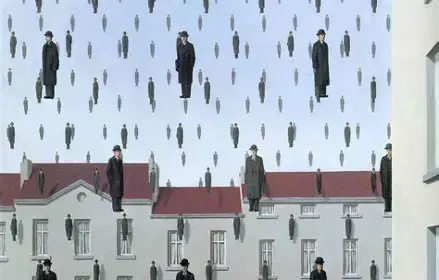
'Magritte used a number of repeated themes throughout his career, probably most famously his Bowler Hat' motif
Magritte is now considered a major figure in the art world and, in my view, has achieved this status by translating his imagination onto canvas and questioning the reality we experience as humans.'


Comments