Art Blog #183
- Paul Connor

- 21 hours ago
- 4 min read
Updated: 1 hour ago
My Top five artists (not in the gallery) Henri De Toulouse-Lautrec

Quick Bio:
Henri Marie Raymond de Toulouse-Lautrec-Montfa (24 November 1864 – 9 September 1901), commonly known as Toulouse-Lautrec, was a French painter, printmaker, draughtsman, caricaturist, and illustrator. His deep involvement in the vibrant and theatrical life of Paris's Belle Époque in the late 19th century enabled him to create popular artworks inspired by decadent events.
Toulouse-Lautrec's parents were first cousins (their mothers were sisters), and his congenital health conditions are often linked to a family history of inbreeding.
At 13, Toulouse-Lautrec broke his right femur, and at 14, he broke his left femur.
The fractures did not heal properly.

Toulouse-Lautrec's legs ceased to grow when he reached 1.52 m (5 ft 0 in).
He developed an adult torso while retaining his child-sized legs.
In 1885, Toulouse-Lautrec encountered Suzanne Valadon. He created numerous portraits of her and encouraged her artistic aspirations. It is thought that they were romantically involved and that she wished to marry him. Their relationship concluded, and Valadon attempted suicide in 1888

In 1890, during the banquet of Les XX exhibition in Brussels, he challenged to a duel the artist Henry de Groux, who criticised van Gogh's works. Paul Signac also declared he would continue to fight for Van Gogh's honour if Lautrec was killed. De Groux apologised for the slight and left the group, and the duel never took place.
Toulouse-Lautrec contributed several illustrations to the magazine Le Rire during the mid-1890s.
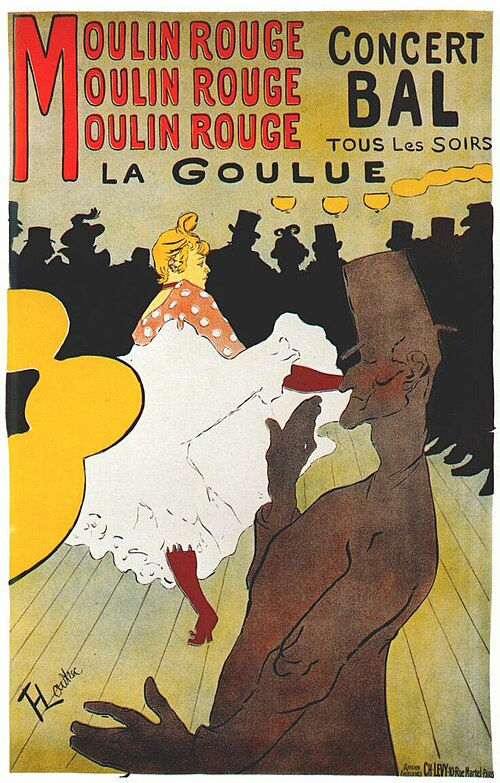
When the Moulin Rouge cabaret opened in 1889, Toulouse-Lautrec was hired to create a series of posters. His mother had left Paris, and although he received a steady income from his family, creating posters provided him with his own livelihood. Other artists looked down on this work, but he paid them no mind.
The cabaret reserved a seat for him and showcased his paintings.
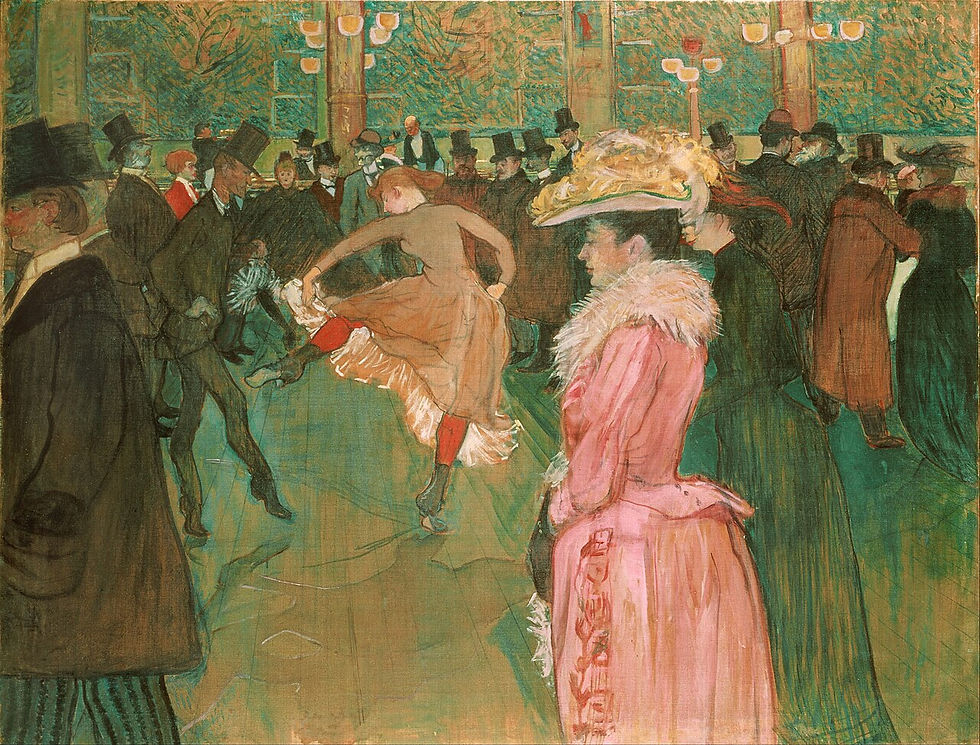
Among the pieces he created for the Moulin Rouge and other Parisian nightclubs are portrayals of the singer Yvette Guilbert; the dancer Louise Weber, better known as La Goulue ('The Glutton'); and the more understated dancer Jane Avril.
He travelled to London, where he was hired by the J. & E. Bella company to create a poster promoting their paper confetti (plaster confetti was prohibited after the 1892 Mardi Gras) and the bicycle advertisement La Chaîne Simpson.
During his time in London, Toulouse-Lautrec met and became friends with Oscar Wilde.
By February 1899, Toulouse-Lautrec's alcoholism began to take its toll, and he collapsed from exhaustion
In March 1901, a stroke left Lautrec paralysed from the legs down and confined him to a wheelchair.
On 15 August 1901, whilst in Taussat, he suffered a stroke which left him hemiplegic
On 9 September 1901, at the age of 36, Toulouse-Lautrec died from complications due to alcoholism and syphilis at his mother's estate

Paul writes:
Henri De Toulouse-Lautrec's life was as vibrant as his palette of colors. Despite his clear physical challenges and his tendency to defy his aristocratic roots, he lived life to the fullest, passing away early at thirty-six.
This man was a burst of energy, not a gradual flame.
His posters showcased movement, with dancers in motion and the band playing, and I believe his work was influenced by Japanese woodblock prints, particularly in terms of unusual vantage points and perspective. For that era in Paris, his posters were revolutionary and bold.
Outside of art he lived life to the full, being an alcoholic, visiting prostitutes, cooking and inventing cocktails and he replicated these experiences in his paintings with a compassion and admiration.
Ukiyo-e was a significant artistic movement in Japan that emerged during the Edo period, particularly flourishing from the 17th to the 19th centuries. This genre of woodblock printing and painting was characterized by its vivid portrayal of the everyday lives and experiences of 'commoners'
The themes of partying, sexuality, and the nocturnal activities of the urban populace were prevalent, showcasing a society that was both vibrant and multifaceted.

In the works of Henri de Toulouse-Lautrec in late 19th-century Paris resonate with similar themes, as he too focused on the underbelly of the social scene, documenting the lives of the bohemian artists, performers, and patrons of the cabarets and dance halls. Lautrec’s art vividly encapsulated the nightlife of Montmartre, a neighborhood that was a hub of artistic innovation and revelry. His paintings and posters often depicted the vibrant figures of dancers, singers, and the patrons who frequented these establishments, revealing the raw and often gritty reality of life in the city.
As a painter, I believe he was not only technically gifted but also possessed a unique ability to capture the essence of the world around him. His work reflects an earthy and organic quality that resonates deeply with viewers, revealing an honesty about his subjects and the topics he chose to explore. This authenticity is strikingly evident in the way he approached his craft, as he did not shy away from the raw and sometimes gritty aspects of life.
His art is exciting, vibrant, and bold, characterized by a fearless use of color and form that commands attention. He offers no quarter, refusing to pander to the expectations of markets or patrons, which is a testament to his integrity as an artist.



Comments